Getting a Texas License to Carry When the Law No Longer Requires One
TL;DR
You need to be 21, a legal resident of Texas for the six months before you apply, and federally qualified to buy a handgun. Members and veterans of the armed forces qualify at 18, as do people holding an active protective order.
Training is four to six hours of classroom instruction plus a range session and a live proficiency demonstration. Take the classroom online, and the law adds a mandatory one to two hours of range instruction before you are allowed to shoot the test.
The published fee is $40 for an original license and $40 to renew, waived entirely for active military, cut to $25 for veterans, and waived under a separate statute for applicants holding a current CPR certification they are not required to hold for work. Texas DPS then has 60 days to act on a complete application, which is not the same thing as 60 days to issue it.
Do You Still Need an LTC in Texas?
No. If you are 21 or older and legally allowed to possess a handgun, House Bill 1927 lets you carry openly or concealed in Texas with no licence at all, and that has been true since September 1, 2021. The question worth asking is not whether you need one. It is whether the licence buys you enough to be worth an afternoon and $40.
The state answers that question on the DPS benefits page, which states plainly that permitless carry "does not repeal the License to Carry a Handgun Program."
What the licence adds:
- It works as an alternative to the federal NICS check when you buy a firearm, so the purchase does not wait on the instant check.
- Campus carry is unchanged and still requires the licence. Permitless carry does not reach a public university campus.
- License holders have protections related to accidentally carrying a firearm into the secured area of an airport.
- Businesses may choose to allow licensed carry on their premises, and licence holders can carry in a government meeting.
- The card is a designated voter ID document, and most businesses must accept it as personal identification.
Then there is travel, which is the one that decides it for most people who drive out of state.
The same department maintains a state-by-state reciprocity table, and as it stands today, 33 states are listed as reciprocal, meaning a Texas licence is honoured there. Another twelve are listed as unilateral, and that word does not mean what people assume: in almost every case it means Texas recognises their licence while Texas holders may not carry in that state. California, New York, Illinois and Maryland all sit in that column. Read the row before you plan the drive, not after.
Who Qualifies, and the Residency Rule Nobody Mentions
The eligibility list lives in
Texas Government Code Section 411.172, and it is longer than the summaries suggest. The headline requirements:
| Requirement | What the statute says |
|---|---|
| Age | At least 21 |
| Residency | Legal resident of Texas for the six months preceding the application |
| Criminal history | No felony conviction; no Class A or B misdemeanor conviction in the preceding five years |
| Pending charges | Not currently charged with a Class A or B misdemeanor or a felony |
| Federal qualification | Fully qualified under federal and state law to purchase a handgun |
| Other bars | Chemical dependency, certain protective orders, delinquent child support or state taxes, and delinquent conduct findings in the preceding 10 years |
The six-month residency line is the one that catches transplants.
Collin County gains people from out of state constantly, and somebody who closed on a house in Frisco or Prosper in June is not eligible in August on that basis alone. Section 411.173 provides a separate nonresident route for legal residents of other states, which requires completing the training in Texas and filing form LTC-6. The identification rules that apply to non-residents and visitors shooting here in the meantime are set out in our FAQ.
The two ways an 18-year-old qualifies
Subsection (g) of the same section makes a person aged 18 to 20 eligible if they are a member or veteran of the armed forces, including the reserves or national guard, and were discharged under honorable conditions where applicable. Subsection (h) adds the caveat worth reading twice: holding that licence "does not affect the person's ability to purchase a handgun or ammunition under federal law", which still sets 21 as the floor for a handgun bought from a dealer.
Subsection (i), added in 2021, opens a second door. A person aged 18 to 20 who is protected under an active protective order or a magistrate's order for emergency protection is eligible on the same terms.
The Classroom Hours, and What Online Actually Costs You
Section 411.188 sets the training. The classroom portion runs not less than four hours and not more than six, covering four subjects: the laws on weapons and the use of deadly force, handgun use and safety including secure carry and restraint holsters, nonviolent dispute resolution, and proper storage practices with an emphasis on eliminating the possibility of accidental injury to a child.
That fourth subject is routinely left out of the summaries floating around. It is also the part of the day most parents say afterwards they were glad to sit through.
Then comes the part that catches people.
You can take the classroom portion online through a DPS-approved online course provider, and the written examination can be administered online through a secure portal. Which sounds like the shortcut it is usually sold as, right up until you read subsection (d-1).
A qualified handgun instructor must require anyone who completed the classroom online to complete not less than one hour and not more than two hours of range instruction before that person is allowed to attempt the physical demonstration of proficiency. In-person students do not carry that requirement.
So the online route does not remove range time. It moves it and adds a mandatory block of it.
For a genuine beginner, that is a better deal than it sounds, since an hour of structured instruction immediately before the test is exactly what a first-time shooter needs. For an experienced shooter who chose online to save a Saturday, it is an hour they did not budget for. Know which one you are before you book.
The Shooting Test, and Who Skips It
The proficiency examination has two parts: a written section on the classroom subjects, and a physical demonstration of proficiency with one or more handguns and in handgun safety procedures. Only a qualified handgun instructor may administer the range portion, and you must apply in person to do it.
Nobody is asking you to shoot like a competitor.
The statutory bar is that an applicant "must be able to demonstrate, at a minimum, the degree of proficiency that is required to effectively operate a handgun". People who have put an hour on a lane beforehand rarely have trouble with it.
There is a real exemption, and it is narrower than the internet suggests. Section 411.1881 excuses the range instruction portion for someone currently serving in or honorably discharged from the armed forces or the Texas military forces, who within the preceding 10 years completed either a course of training in firearm proficiency or familiarization, or a range qualification process, as part of that service. Note what it does and does not do: it addresses the range instruction, and it runs on a 10-year clock. A veteran discharged in 2010 does not qualify on service alone.
A separate section, 411.1882, lets certain judges, prosecutors, clerks, and probation officers establish proficiency through a sworn statement from an approved instructor instead.
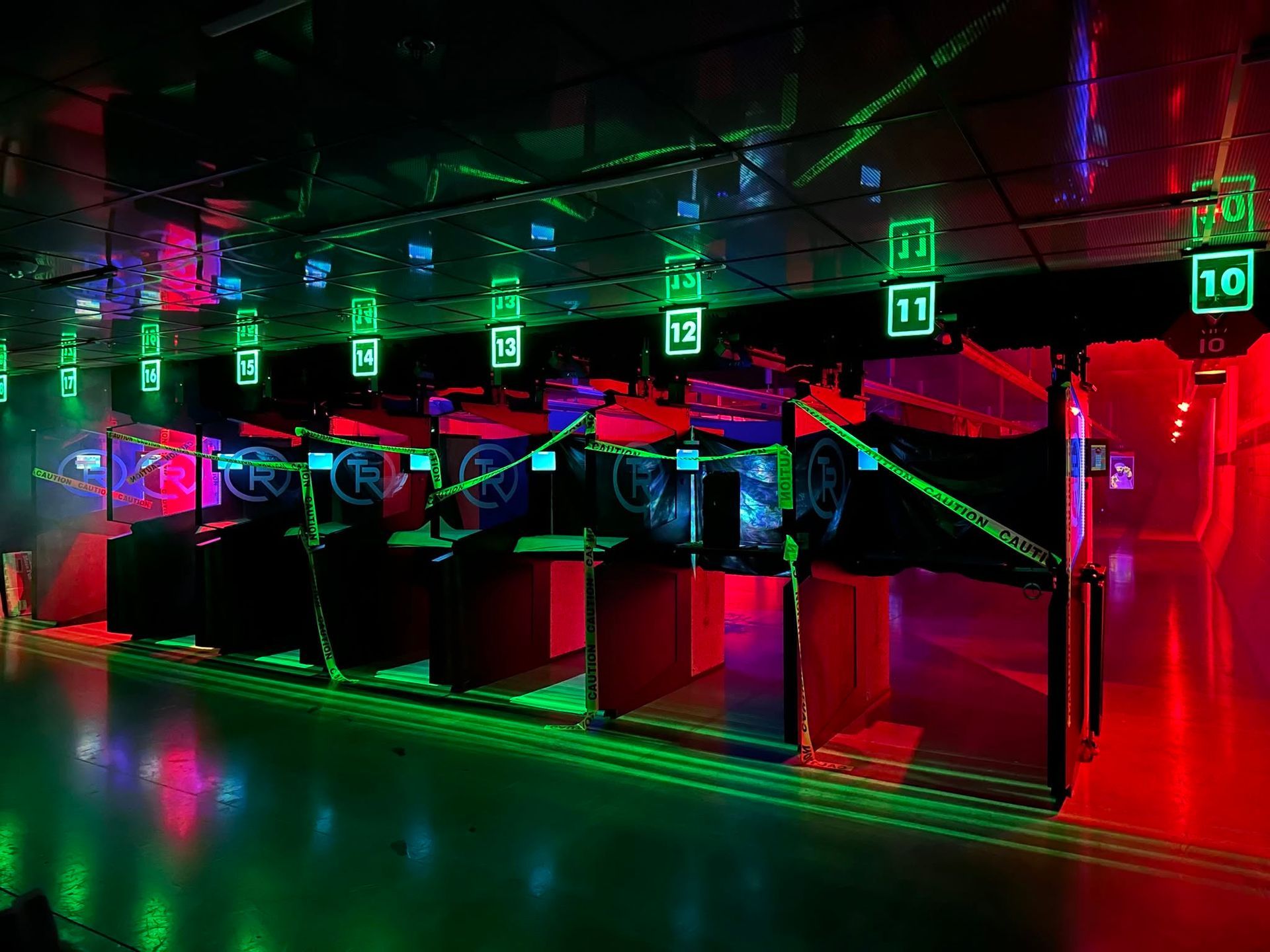
If you have never fired a handgun, the sensible order is to put an hour on a lane before you ever book the class. Our indoor range, McKinney, rents pistols by the hour and a first-time shooter gets an instructor in the lane, which turns the proficiency demonstration from the thing you are dreading into a formality.
What to practise beforehand
Almost nothing on the test is about marksmanship, and the things that trip people up are mechanical.
Loading and seating a magazine under mild pressure. Racking a slide from a fresh grip without needing a table edge. Clearing a stoppage without turning around. Keeping the muzzle downrange while you do any of it. An hour spent on those four things is worth more than three hours of slow fire at a bullseye.
Borrowing a gun for the test is also worth thinking about in advance. A pistol that fits your hand badly makes an easy standard harder for no reason, and a rented. 22 or a mild 9mm is a kinder choice for the demonstration than somebody's snappy carry compact. The test does not care what you shoot it with.
One more practical note for anyone in Collin County booking around a work schedule: the range portion has to be done in person with a qualified instructor, so it is the piece of the process that has to fit a calendar. Everything else can be done from a kitchen table.
What It Actually Costs
Two numbers belong to the state and the rest belong to whoever trains you. The published fee table carries a long list of discounts, and they are worth reading before you pay the standard rate.
| Applicant | Original | Renewal |
|---|---|---|
| Standard | $40 | $40 |
| Senior citizen (60 or older) | $40 | $35 |
| ndigent | $40 | $35 |
| Veteran, honorably discharged more than 365 days ago | $25 | $25 |
| Active military or active Texas military member | $0 | $0 |
| Veteran within 365 days of honorable discharge | $0 | $0 |
| Active or honorably retired peace officer, county jailer, TDCJ correctional officer | $0 | $0 |
| Juvenile probation or supervision officer | $25 | $25 |
Budget beyond the state fee for the training course, the fingerprint vendor, and the ammunition you will use for practice and the demonstration itself. Those vary by provider and are not set by DPS.
The CPR waiver almost nobody claims
Section 411.1954 waives any fee required for an original or renewed licence if the applicant holds a current CPR certification issued by the American Heart Association, the American Red Cross, or another nationally recognised association, and is not required to hold that certification as a condition of employment or an occupational licence.
Read that again. It is a full waiver rather than a discount, and it does not appear on the fee table alongside the other special conditions.
If you took a CPR class voluntarily, the statute says the fee goes away. Ask for it to be applied when you file, and be ready to submit the certificate as evidence.
How Long Does It Take to Get a Texas LTC?
Sixty days, from the moment your completed application materials arrive. The statute is careful about what has to happen in that window. Under Section 411.177(b), the department must do one of three things by the 60th day: issue the licence, notify you in writing that it was denied, or notify you that it cannot decide in time, with an explanation and an estimate of how much longer it needs.
That third option is the one people are surprised by.
Sixty days is a deadline to act, not a promise to issue. The backstop sits in subsection (c): failing to issue or deny for more than 30 days past that point counts as a denial, which at least gives you something to appeal rather than an open-ended wait.
There is also a fast lane most guides never mention. Section 411.184 requires an expedited procedure for people at increased risk of becoming a victim of violence, and where the applicant qualifies, the department has 10 days rather than 60 to issue the licence with the designation.
Eligibility runs on protective orders, magistrate's orders for emergency protection, or participation in the address confidentiality program. No extra charge applies to the designation, and where it is filed alongside an original application, only the licensing fee is due.
Where the Weeks Actually Go
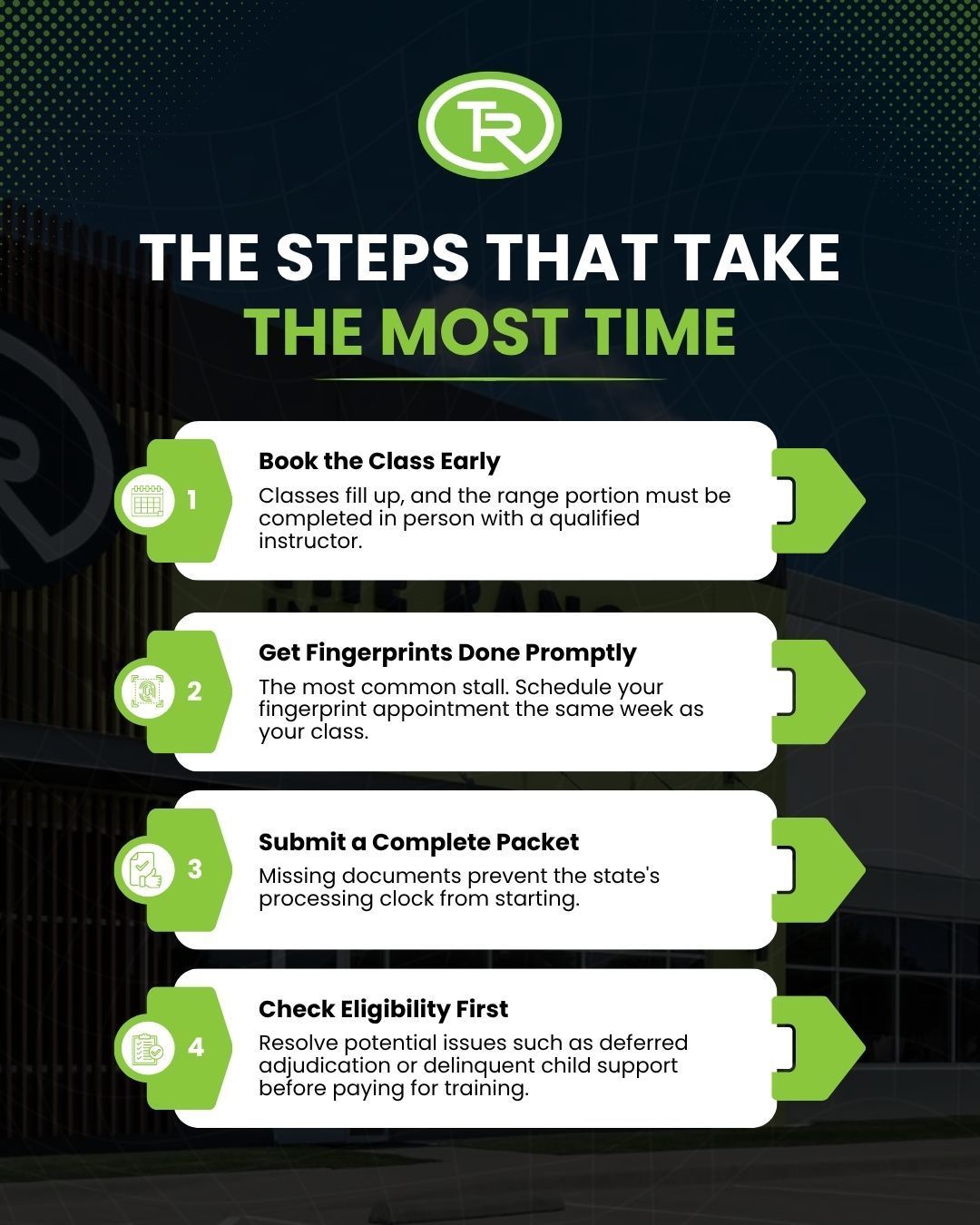
The state's clock only starts when your packet is complete, so most of the delay people complain about happens before the file is ever opened in Austin.
- Booking the class late. Classes fill, and the range portion has to be scheduled with a qualified instructor in person.
- Sitting on fingerprints. The single most common stall. Book that appointment the same week as your class, not after it.
- Filing an incomplete packet. Missing documents do not pause the clock; they prevent it from starting.
- Finding an eligibility problem at the end. A deferred adjudication or a delinquent child support finding is worth resolving before you pay for training.
Getting the Training Side Done in McKinney
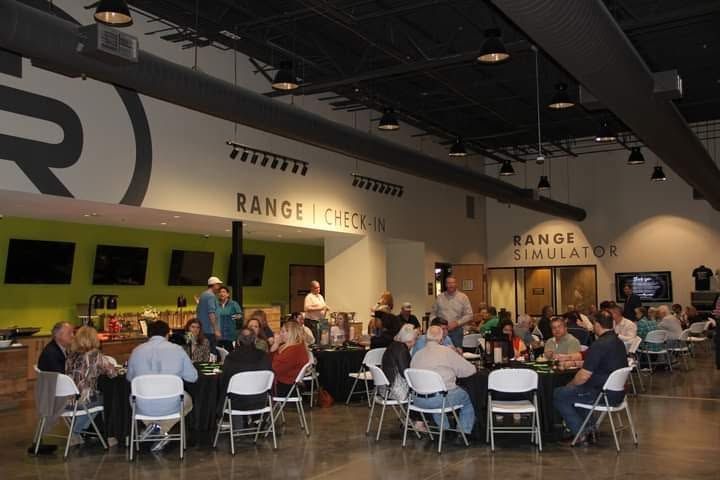
The licence is a paperwork exercise with one in-person requirement at its centre, and that requirement is where a range with instructors on staff earns its keep. The instructors here hold certifications through U.S. LawShield and the NRA; several are active-duty military or law enforcement, and the classroom and the lanes sit in the same building, so the range portion is not a second appointment across town.
If your reason for getting the licence is school or church safety work, the Texas Guardian Program requires a valid LTC before anything else, so this is the first step rather than a parallel one. Our rundown of what we run under one roof covers the rest of what is available once the licence is in your wallet.
Book an LTC class in McKinney with us, or call (972) 330-4415 and tell us where you are in the process. We are at 415 Industrial Blvd, and The Range in McKinney is open Tuesday through Saturday, 10 AM to 7 PM, and Sunday, noon to 6 PM.
Frequently Asked Questions
What are the Texas license to carry requirements?
Be 21 or older, a legal Texas resident for the six months before applying, and federally qualified to buy a handgun, with no disqualifying convictions or orders. Then complete four to six hours of classroom instruction, pass a written exam, and demonstrate handgun proficiency on a range.
How much does a Texas LTC cost?
The DPS fee table sets $40 for an original license and $40 to renew. Active military pay nothing, veterans discharged more than a year ago pay $25, and the statute waives the fee entirely for applicants holding a voluntary CPR certification. Training, fingerprints, and ammunition are separate.
Can you take the Texas LTC class entirely online?
The classroom portion and the written exam can be done online through an approved provider. The range portion cannot, and taking the classroom online triggers a statutory requirement of one to two hours of range instruction before you may attempt the shooting demonstration.
How long does DPS take to issue an LTC?
Sixty days from receipt of a complete application, but the statute requires DPS to issue, deny, or explain the delay by that date rather than guaranteeing a license. Applicants who qualify for the at-risk designation get an expedited 10-day track.
Do veterans skip the LTC shooting test?
Serving members and honorably discharged veterans are exempt from the range instruction portion if they completed firearm proficiency training or a range qualification during service within the preceding 10 years. The exemption runs on that 10-year clock, not on service alone.
The Range in McKinney
415 Industrial Blvd., McKinney, TX 75069
Tuesday–Saturday 10 a.m.–7 p.m. | Sunday 12 p.m.–6 p.m. | Closed Mondays