Indoor Gun Range Ammo Rules: What You Can And Can't Shoot In McKinney
TL;DR
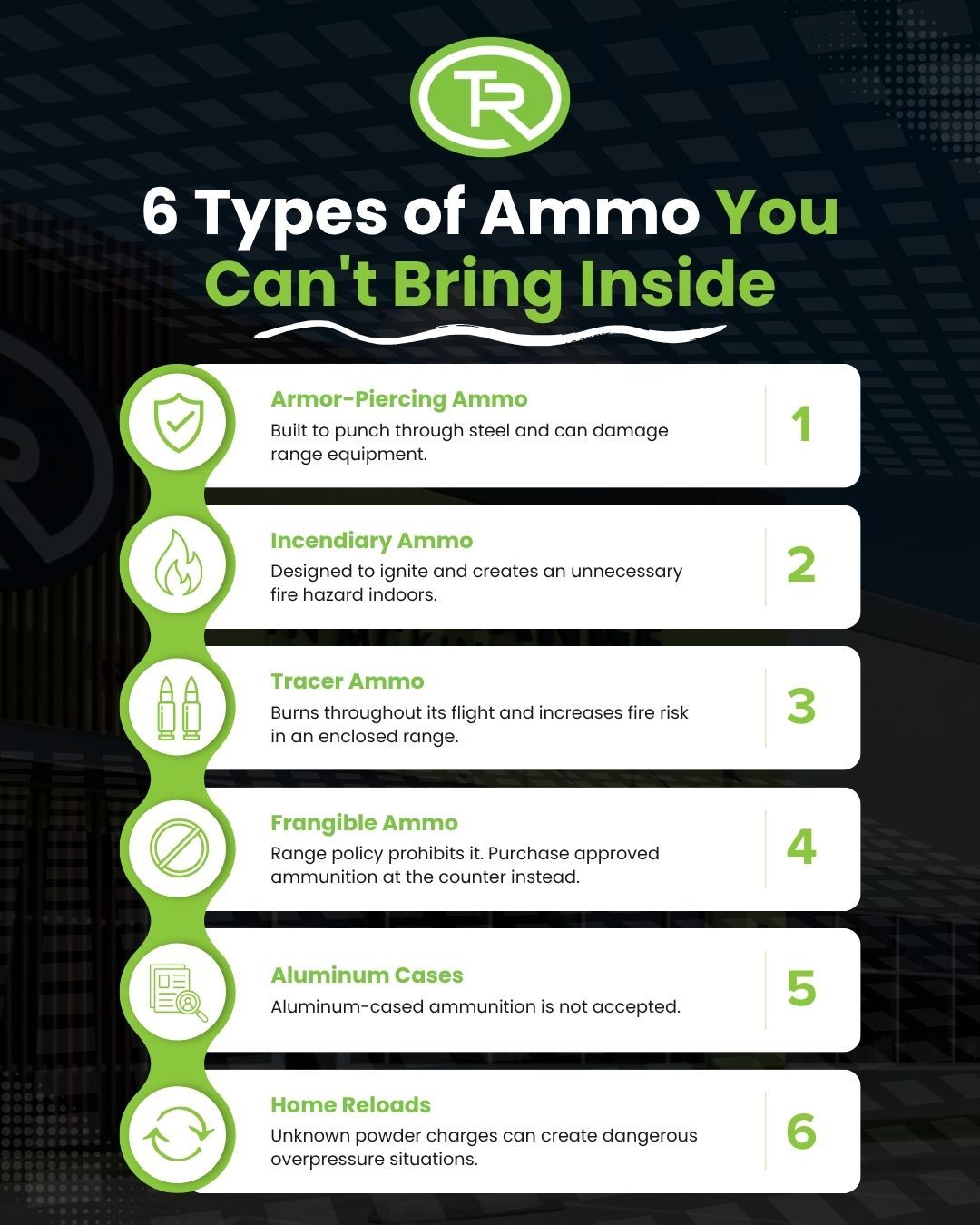
Prohibited on our lanes: steel core, steel jacketed, green tip, armor-piercing, incendiary, tracer, frangible, aluminum cases, and home reloads. Shotguns fire slugs only, never birdshot or buckshot. Black powder firearms are out. The posted maximum caliber is 500 S&W.
Every round is subject to inspection, and the posted penalty for using prohibited ammunition on the range is immediate expulsion plus a $500 fine, so the sensible move is to leave a doubtful box in the car rather than find out at the firing line. You may bring your own ammunition for your own firearms. A rental gun runs ammunition bought at our counter, with no exceptions.
Three Reasons a Round Gets Refused
Every banned round on our list fails one of three tests, and once the categories are clear, the list stops looking arbitrary.
It can damage the trap. Hard metal in a bullet chews up a backstop built to catch lead, and a shot-out trap is a repair bill measured in thousands.
It can throw something back at you. Hard cores and hard jackets ricochet in ways soft lead does not, and the firing line is fifteen yards behind whatever the bullet just hit.
It can start a fire. Anything designed to burn on its way downrange is an ignition source inside a closed building with unburnt powder on the floor.
That third category is worth being precise about, because the popular version of it is wrong. The Sporting Arms and Ammunition Manufacturers' Institute, the standards body that writes the dimensional and pressure specs the whole industry builds to, produced a study with the International Fire Chiefs Association on how sporting ammunition behaves in a fire. Their finding was that ammunition outside a firearm "is unlikely to ignite under extreme conditions of impact", "will not propagate in a chain reaction from one cartridge or shell to another" and "does not mass explode".
So a case of ammunition sitting on a shelf is not a bomb. A tracer already burning at 1,200 feet per second, six inches from a rubber trap, is a different proposition entirely. The rule exists for the round in flight, not the round in the box.
What Is Actually Prohibited on Our Lanes
Here is the posted list, with the reason attached to each so you can predict the answer for anything not named. Here is the posted list, with the reason attached to each so you can predict the answer for anything not named.
| Round | Why it is refused |
|---|---|
| Steel core | Steel in the bullet damages the trap and ricochets |
| Steel jacketed | Same hard-material problem, one layer out |
| Green tip (M855 / SS109) | Hardened steel penetrator ahead of the lead core |
| Armor piercing | Built to defeat steel, hard on every trap ever made |
| Incendiary | Designed to ignite indoors, in a building |
| Tracer | Burns the whole way downrange |
| Frangible | Excluded by our written policy |
| Aluminum cases | Not accepted |
| Home reloads | We cannot confirm the powder charge |
| Shotgun shot | Slugs only, no birdshot, no buckshot |
| Black powder firearms | Not permitted on the range at all |
Two things about that table are worth saying out loud, because they are the parts that surprise people who have shot at other ranges.
All ammunition is subject to inspection at any time, and that is not a formality. Bring prohibited rounds into the building, and we will tell you to take them back to your car. Fire them on the lane, and the penalty printed on our indoor gun range in McKinney page applies: immediate expulsion plus a $500 fine. In our experience, nobody has ever done it on purpose. They grabbed the wrong box off the shelf at home, which is exactly what the thirty-second check further down is designed to prevent.
The second is that "no reloads" is narrower than most people repeat it. We do not allow home reloads. Commercial reloads are allowed. If a licensed manufacturer loaded it to published pressure specs and stands behind it, it is welcome here. If it came off your buddy's press in his garage, it stays home, because nobody in this building can verify what is inside that case, and an overpressure handload wrecks the gun and the hand holding it.
Is Green Tip Actually Armor Piercing?
No, and this is the single most repeated mistake in every range-rules article on the internet. Green tip 5.56 is banned here for what it does to a steel trap, not because it meets the federal definition of armor-piercing ammunition. Those are two different questions with two different answers, and conflating them is how bad advice spreads.
The definition lives in 18 U.S.C. 921(a)(17)(B). A projectile is armor-piercing if it is "constructed entirely from one or a combination of tungsten alloys, steel, iron, brass, bronze, beryllium copper, or depleted uranium", or if it is a full jacketed projectile larger than .22 caliber whose jacket weighs more than 25 percent of the total weight of the projectile.
Read that first clause carefully. M855 and its NATO twin, the SS109, carry a hardened steel penetrator seated ahead of a lead core, under a copper jacket. A bullet with a lead core is not constructed entirely from the listed metals, so it falls outside the statutory definition, which is why green tip has remained a legal over-the-counter rifle round for decades.
None of which changes our answer at the counter. The steel penetrator still tears up a trap and still sparks, so green tip does not go downrange here. Plain brass-cased lead or full metal jacket 5.56 is welcome, and your AR is welcome with it. The restriction is on the round, never on the rifle.
Why does the distinction matter if the outcome is the same? Because it tells you how to shop. If green tip were federally restricted, you would be looking for a legal substitute. It is not, so you are only looking for a cheaper one, and every 55-grain brass-cased M193-style load on the shelf qualifies.
The same reasoning sorts out the rest of your ammunition can. Ask what the bullet is made of rather than what the box is called. Marketing names travel; construction does not.
What to bring for an AR instead
Standard 55 or 62 grain full metal jacket in brass cases, with no painted tip and no penetrator, is what most people already own and what most of our rifle shooters run. If the headstamp says it came from a commercial loader and the nose is bare copper, you are fine.
Phone ahead about steel-cased 5.56, for the reasons in the next section. Surplus ammunition of unknown origin is the one genuinely worth leaving home, because "surplus" tells you nothing about the core, and the person who sold it at a gun show usually could not tell you either.
Steel Case and Steel Core Are Not the Same Problem
This is the mix-up that starts arguments at gun counters across Collin County, so here is the clean version.
A steel core round has steel inside the bullet itself. That metal is what damages the trap, throws sparks, and comes back off the backstop at an angle nobody planned. It is a safety rule.
With a steel case, only the cartridge case is steel instead of brass. The bullet is ordinary lead and copper. Cheap imported ammunition is usually where you meet it, and it is a cost question for the range rather than a danger to the shooter, because spent steel mixed into a brass bucket ruins the value of the whole batch.
A magnet cannot reliably tell you which one you are holding. It tugs at a steel case, a steel jacket, and a steel core with the same enthusiasm, and some budget imports wrap a mild steel jacket under a thin copper wash that also grabs. Treat a magnet as a first screen that produces false positives, never as the final word.
Our written policy names steel core, steel jacketed, and aluminum cases. Plain steel case is not on it. If steel-cased range ammunition is what you were planning to run, call the counter at (972) 330-4415 before you make the drive from Allen or Princeton, because a two-minute phone call beats repacking your bag in the parking lot.
Can You Shoot a Shotgun at an Indoor Range?
Yes, with slugs. That is the whole rule, and it catches out more visitors than anything else on this page. No birdshot, no buckshot, no turkey loads, nothing that leaves the muzzle as a spreading pattern of pellets.
The reason is geometry. A slug is one projectile going to one place on a trap designed to receive it. A pattern of pellets arrives spread across a wide area at unpredictable angles, hits structures the trap was never meant to catch, and behaves nothing like the single impact an indoor backstop is engineered around.
If you came in to pattern a shotgun before dove or quail season, this is the moment to know that an indoor lane is the wrong tool for the job. Come in to run slugs, check your sights, and confirm the gun cycles. Do your patterning outdoors where a spreading load has room to open up.
Pellet guns, full auto, and the other edge cases
The odd questions get real answers, and they are not the ones most people guess.
Lead .177 caliber pellets may be shot on our lanes. Steel pellets and BBs of any sort may not, and that one is purely about what bounces back off a hard surface.
Legally owned select-fire and full-auto firearms are welcome, with proper documentation. Ask a range safety officer or call ahead if you are unsure about your particular gun.
Black powder firearms are prohibited outright. That is a firearm rule rather than an ammunition rule, and it is a flat no rather than a judgment call.
You may pick up your own brass by hand, and only your own. Range equipment does not get used for brass collection.
The Caliber Ceiling and the Number That Confuses People
Our published maximum caliber for the range is 500 S&W. In practice, that covers everything a civilian shoots, from a 22 rimfire up through the big-bore handgun magnums, and almost nobody gets anywhere near it.
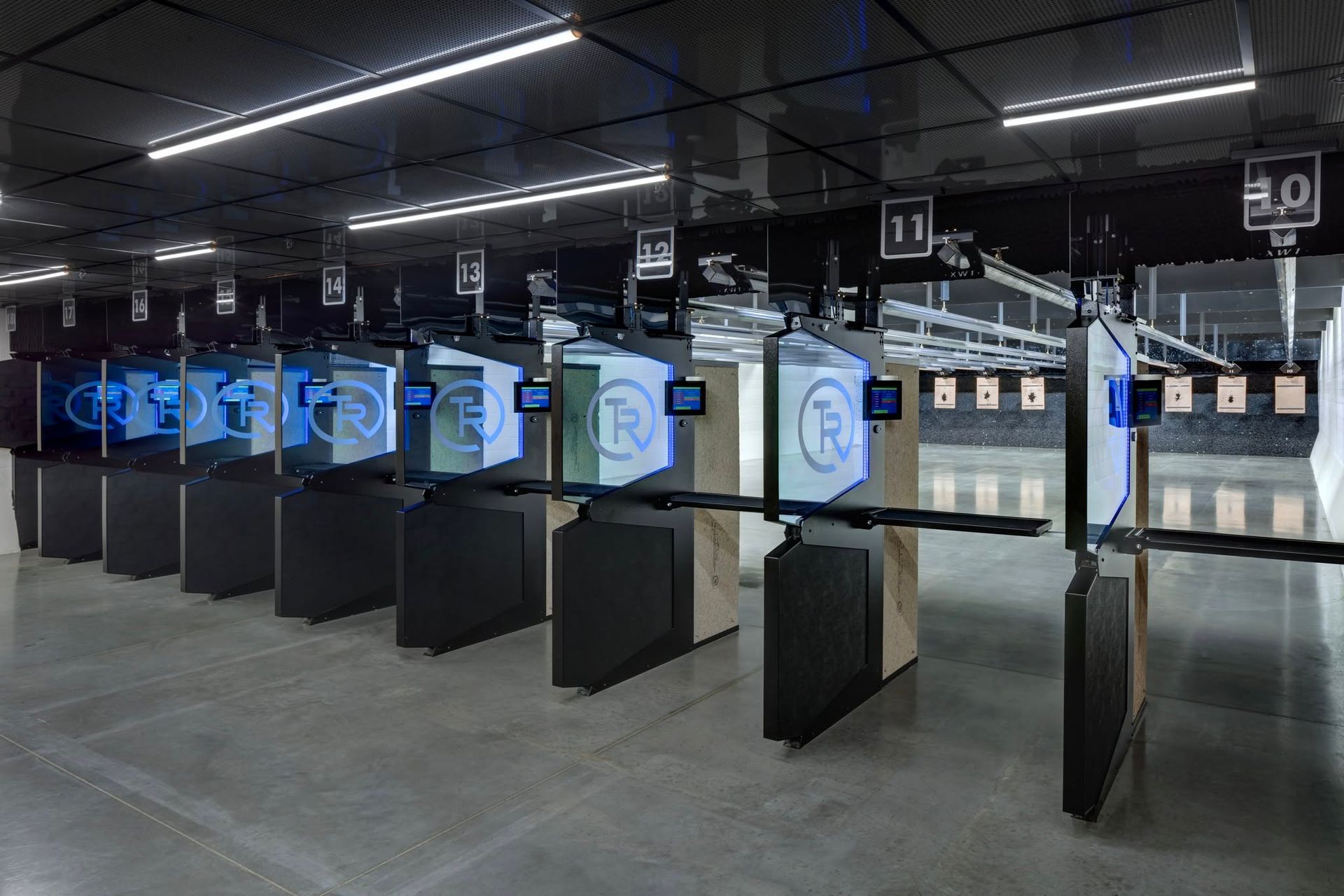
You will also see a larger number on our own equipment description, because the Inveris SafeZone stalls are rifle- and pistol-rated and the rubber trap is rated up to 50 BMG. Those two figures answer different questions. The trap rating is what the hardware can absorb. The 500 S&W figure is the policy limit on what we allow through it, and the policy limit is the one that governs your visit.
If you are bringing something genuinely unusual, the site says it plainly and so will we: if you are in doubt about your specific gun or ammunition combination, ask an employee before shooting. That sentence is on the range rules for a reason, and using it has never once annoyed anybody behind our counter.
Bringing Your Own Ammo, and the One Time You Cannot
For your own firearm, bring what you like as long as it clears the list above. Buying online by the case and hauling a few boxes in is completely normal here, and nobody is going to nickel and dime you over it.
Rentals are the exception, and the rule is firm. A rental gun runs ammunition bought from us, and personal ammunition never goes into one. We want to know exactly what is cycling through a firearm that somebody else will shoot next week, which protects you, the next renter, and the gun.
| Situation | Allowed? |
|---|---|
| Your gun, your ammunition, off the prohibited list | Yes |
| Your gun, ammunition bought at our counter | Always |
| Rental gun, ammunition bought at our counter | Required |
| Rental gun, your own ammunition | Never |
Ammunition is also where a bad decision turns into a repair bill. An overpressure handload or a round the gun was never chambered for does not politely fail; it bulges a barrel or cracks a slide, and then the gun goes to a bench rather than back in the case. If something already went wrong and the gun is not right afterward, our gunsmith will tell you whether it is a wearing part or a structural problem before you fire it again.
A Thirty Second Ammo Check Before You Drive Over
Two habits cover nearly every case, and neither of them requires memorising this page.
Read the box. The words steel, penetrator and tracer are all the warning you need, and anything with a green painted tip goes back on the shelf. Anything you loaded yourself stays home.
Touch a magnet to the bullet nose if a rifle round has you unsure. A hard grab means treat it as steel and leave it behind, accepting that you will occasionally leave perfectly legal steel-case ammunition at home for nothing.
On the days you genuinely cannot tell, buy it here, because every round on our shelf is already cleared for our lanes. Planning a first trip with a group? Our guide to bringing a group to the range covers how much ammunition to budget per shooter, and the full guns and ammunition rules are on our FAQ page.
Come shoot at The Range in McKinney, 415 Industrial Blvd, or pick up cleared rounds at our counter on the way to your lane.
Frequently Asked Questions
What ammo is allowed at an indoor gun range?
Standard brass-cased lead, full metal jacket, and hollow point in ordinary calibers. Our lanes refuse steel core, steel jacketed, green tip, armor piercing, incendiary, tracer, frangible, aluminum cases, and home reloads, and shotguns fire slugs only.
Can you bring your own ammo to a gun range?
Yes, for your own firearm, provided it is not on the prohibited list. The exception is rentals: a rental gun must run ammunition purchased at our counter, and personal ammunition never goes into one.
Why is green tip banned at indoor ranges?
Because the M855 round carries a hardened steel penetrator that damages steel backstops and throws sparks. It is not legally armor-piercing under 18 U.S.C. 921, since the bullet has a lead core, but the steel is the problem for our trap.
Is steel case ammo the same as steel core?
No. Steel core means steel inside the bullet, which is a safety issue. Steel case means only the cartridge is steel, which is a cost issue for ranges that sell spent brass. Our written policy names steel core, not plain steel case.
Can you shoot a shotgun at an indoor range?
Slugs only on our lanes, never birdshot or buckshot. A spreading pattern of pellets hits an indoor backstop across an area it was never built to catch, so shotgun patterning belongs outdoors.
The Range in McKinney
415 Industrial Blvd., McKinney, TX 75069
Tuesday–Saturday 10 a.m.–7 p.m. | Sunday 12 p.m.–6 p.m. | Closed Mondays
·
Schedule
a
lesson
·
Plan an event