The 25 Yard Zero, and Why It Is Only Half the Job
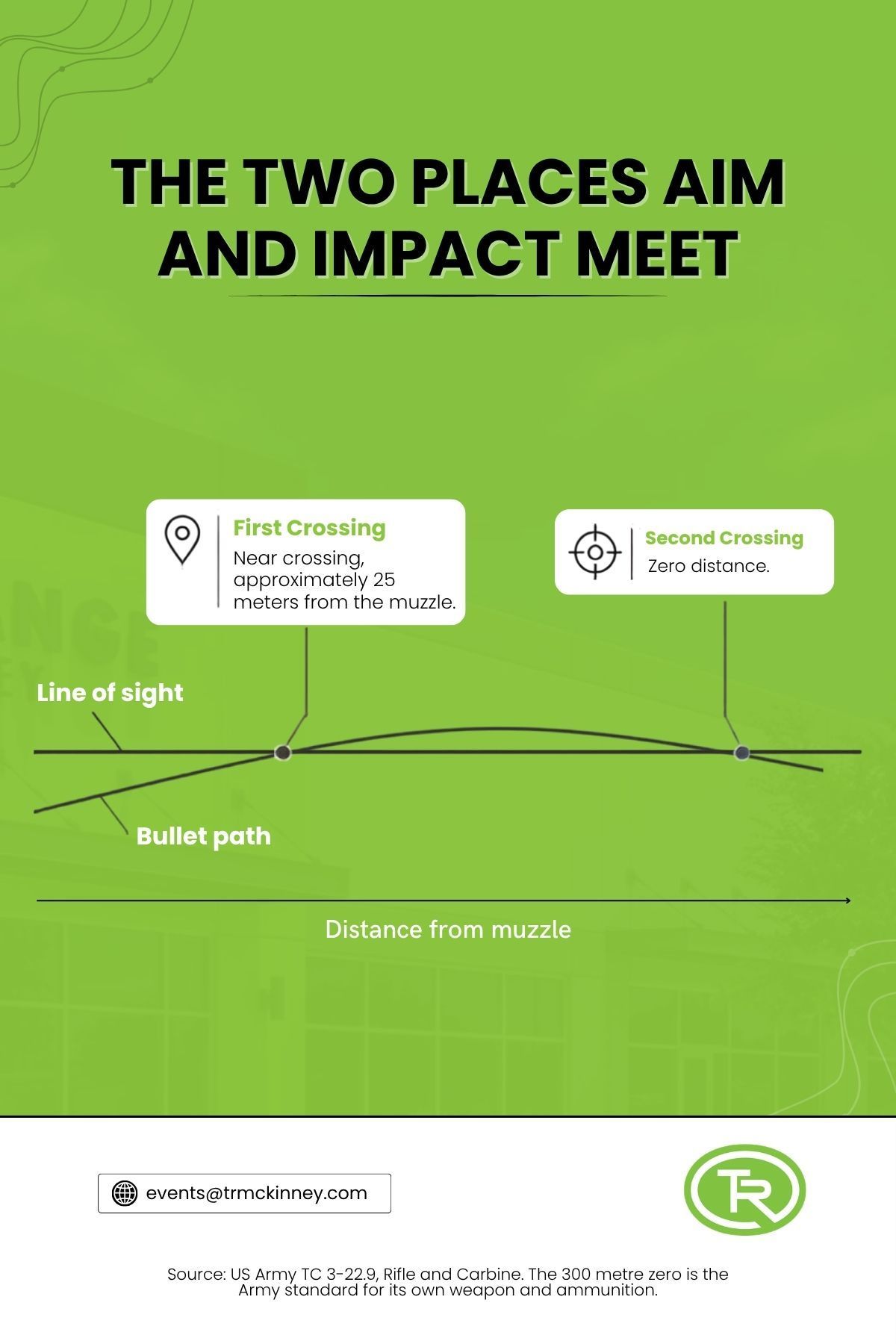
A bullet does not travel along your line of sight. It crosses it twice, and the first crossing happens close to the muzzle. That is the reason a 25-yard lane is genuinely useful for setting a zero and genuinely incapable of confirming one, and knowing which of those two jobs you are doing on a given afternoon is most of what separates productive practice from expensive noise.
TL;DR
Sights sit above the bore, so the bullet starts below the line of sight, rises through it, and drops back through it further out. The Army's rifle manual puts the near crossing at approximately 25 meters from the muzzle. That makes a short lane the right place to build a group and set an initial zero, and the wrong place to confirm where rounds land at distance. Its own guidance is blunt: having a 25 metre zero does not guarantee a centre hit further out. Everything else a short lane teaches is fundamentals, and those are the things that actually limit most shooters.
Why Does the Bullet Cross the Line of Sight Twice?
Because the sights and the barrel are not the same line, and gravity acts on only one of them.
Your optic or your iron sights sit an inch or more above the bore. Point them at a target, and the barrel is angled very slightly upward relative to your line of sight. The bullet leaves below that line, climbs through it, travels above it for a stretch, and then falls back through it.
The Army's rifle and carbine manual states the consequence precisely. Point of aim and point of impact coincide only twice on the bullet's path to a distant target: once when the trajectory crosses the line of sight approximately 25 meters from the muzzle, and again at the zero distance.
Everywhere else, the bullet is either below or above your line of sight.
What that means in a 25-yard lane
You are standing at, or very near, the first crossing. That is a genuinely useful place to be, because at that distance the bullet has barely had time to be affected by anything except how well you pointed the gun.
From there, you cannot see what the round does afterwards. The whole arc, the whole drop, and the second crossing all happen outside the building.
Grouping Comes Before Zeroing
The single most common wasted afternoon at a range is somebody adjusting sights before they can shoot a group, and military doctrine puts these in a strict order for exactly that reason.
The manual describes grouping and zeroing as done at 25 meters, and it separates them. The goal of the grouping exercise is to fire tight shot groups and to place those groups consistently in the same location. Its stated reason is that tight, consistently placed groups show the shooter is applying proper aiming and smooth trigger control before the adjustment process begins.
Only after that does the firer begin moving the group to the centre of the target.
Read that sequence backwards, and the failure mode is obvious. A shooter with a twelve-inch spread who starts turning turrets is chasing randomness. Each adjustment moves an average that is not stable enough to move, and the group ends up somewhere different rather than somewhere better, with a box of ammunition gone.
The honest self-test
Fire five rounds without touching the sights. Do not look at where they landed relative to the bullseye. Look only at how close they are to each other.
If the group is tight, you have earned the right to adjust something. If it is not, the sights are not your problem, and moving them will make the day worse. Go back to the fundamentals that produced the spread, which is what the manual means by proper aiming and smooth trigger control.
That test costs five rounds, and it is the highest-value thing anybody does in a short lane.
What a Short Lane Cannot Do?
Here is the part a range should tell you plainly rather than let you find out later.
Setting a zero at close distance is a starting point, not a finished job. The Army manual is unambiguous: the most important step in the zeroing process is confirmation at the zero distance, and having a 25 metre zero does not guarantee a centre hit at 300 metres.
Two things make that true. Small angular errors grow with distance, so a group that is fractionally off at 25 is meaningfully off further out. And the environment starts acting on the bullet. The same manual notes that when confirming zero past 100 meters, wind has to be considered, and that a zero confirmed on a windy day will produce different impacts when the rifle is fired later in different conditions.
None of that is visible indoors. An indoor lane has no wind, no mirage, and no distance for either to act over. That is a feature for isolating your technique and a limitation for predicting your ballistics.
So what is an indoor zero for?
It gets you on paper, and on a known offset, before you spend time and ammunition at distance.
Arriving at a longer range with a rifle already grouping well and already close is a completely different afternoon from arriving with an unzeroed rifle and no idea where it shoots. The short lane does the first half of the job efficiently and cheaply. The confirmation is the second half, and it happens somewhere else.
Depending on the aiming device, there may also be a deliberate zero offset to use at close distance rather than aiming for dead centre. Check what your specific optic calls for before assuming the goal is a centred group.
What Is Worth Practising at 25 Yards?
Almost everything that actually limits shooters, because the things that limit people are not distance-related.
Trigger control is the same skill at every distance, and it is easier to diagnose up close, where the sights are steadier and a jerk shows up as a distinct flyer rather than as general spread.
What the manual calls "sight alignment" and "sight picture" behaves identically at any range. The manual's own definitions treat point of aim as where the line of sight intersects the target, and getting that repeatable is a technique problem, not a distance problem.
Position and stability transfer directly. A stable position that produces a tight group at 25 will still be a stable position at 100. An unstable one that is forgiving up close will fall apart.
Recoil management, reloading, malfunction clearance, and the transition between targets are all range-independent skills and all easier to build in a lane than on a longer line where the round count per hour is lower.
The one thing a short lane genuinely cannot teach is reading conditions, because there are none. That is the skill that requires an outdoor line and time.
The instruction side of all of that is what our training services exist for, and the lanes here run out to 25 yards, rated for pistol and rifle. Before you bring a rifle in, check what ammunition an indoor range allows, because the backstop sets limits that have nothing to do with what your rifle can fire.
What Changes Between 25 Yards and Distance
Three things, and only one of them is about the shooter.
The first is angular error. A shot that is off by a small angle at the muzzle is off by a proportionally larger distance the further it travels. That is why a group which looks acceptable in a lane can be genuinely poor further out, and it is the mathematical reason a close zero needs checking at distance rather than trusting.
The second is the environment. Indoors there is no wind and no mirage. The manual notes that past 100 meters, wind has to be considered when confirming a zero, and that a zero confirmed on a windy day produces different impacts on a still one. A lane removes that variable entirely, which is useful for isolating technique and misleading if you forget it has been removed.
The third is the shooter, and it is the one that does transfer. Position, breathing, trigger control, and follow-through are the same actions at any distance. If they are inconsistent at 25, they will be worse at 100, because distance amplifies rather than forgives.
Why that ordering is good news
It means the majority of what limits most people is trainable in a short lane, cheaply and with a high round count per hour.
Most shooters are not held back by ballistics. They are held back by a trigger press that moves the gun, a position that is not repeatable, or an inconsistent grip. All of those show up clearly at 25 yards, and all of them can be worked on in an afternoon, indoors, in comfort, without driving anywhere.
The ballistics half is real, and it is smaller than people think, and it is also the half that needs a longer line.
What About Pistol Work?
Most people in a 25-yard lane are shooting a handgun, and the geometry question mostly goes away.
A pistol's sights sit lower over the bore, the practical distances are shorter, and for defensive-distance work the trajectory is close enough to flat that the two-crossing problem is not what limits anybody. Twenty-five yards is a long shot with a handgun rather than a short one.
Which means for pistol shooters the lane is not a compromise at all. It covers the full practical distance envelope, and the entire session can go on the fundamentals, the draw where the range permits it, reloads, and shooting at speed with an acceptable standard rather than slowly with a perfect one.
The rifle caveat in this article is a rifle caveat. It is worth knowing if you bring a carbine to an indoor lane, and it changes nothing about handgun practice.
Why Indoor Air Handling Matters More Than People Think
Worth a section, because it is a real consideration when you are choosing where to spend hours in a confined space, and because most shooters have never thought about it.
Firing indoors produces airborne lead. The federal guidance on protecting people from lead hazards at indoor firing ranges lists the routes plainly: shooting firearms with lead bullets or lead-containing primers creates airborne lead in the gun smoke, bullet deformation and fragmentation at the trap causes exposure, and handling spent cartridges or cleaning firearms contaminates hands and skin.
It also states something specific about ventilation that is worth understanding as a customer. A building's standard HVAC system may not adequately remove airborne lead particles from the range. The recommended engineering control is a separate push-and-pull ventilation system, not connected to the general HVAC, moving air downrange from the firearm toward a filtered exhaust behind the bullet trap, with HEPA filtration.
That is why a range describing its air as supplied fresh and never recirculated is describing an engineering choice rather than a comfort feature.
What you can do yourself
The same guidance names the personal habits that matter, and they cost nothing.
Do not eat, drink, or smoke in the range area. Wash hands and face before you do any of those things afterwards. Be aware that handling spent brass and cleaning firearms both put residue on your hands.
None of that is alarming, and all of it is worth doing every visit.
A Sensible Way to Use the Lane
If you have an hour and a rifle you are not confident in, this is the order that gets the most out of a short lane.
- Confirm the rifle is safe, and the optic is mounted tight, before any of the rest matters
- Fire a five-round group without adjusting anything, and judge the group by its own size
- If the group is not tight, spend the session on fundamentals rather than on adjustment
- If it is tight, move it to your intended point of impact for that distance
- Fire a confirming group to prove the adjustment took
- Book the trip to a longer line, because the zero is set and not yet confirmed
Step six is the one people skip. Everything before it is preparation for it.
Set the Zero Here, Confirm It Somewhere Longer
A 25-yard lane is where a bullet first crosses your line of sight, which makes it the right place to build a group, set an initial zero, and work on the technique that limits almost everybody. It is not where you find out what your rifle does at distance, and any range that tells you otherwise is selling you something.
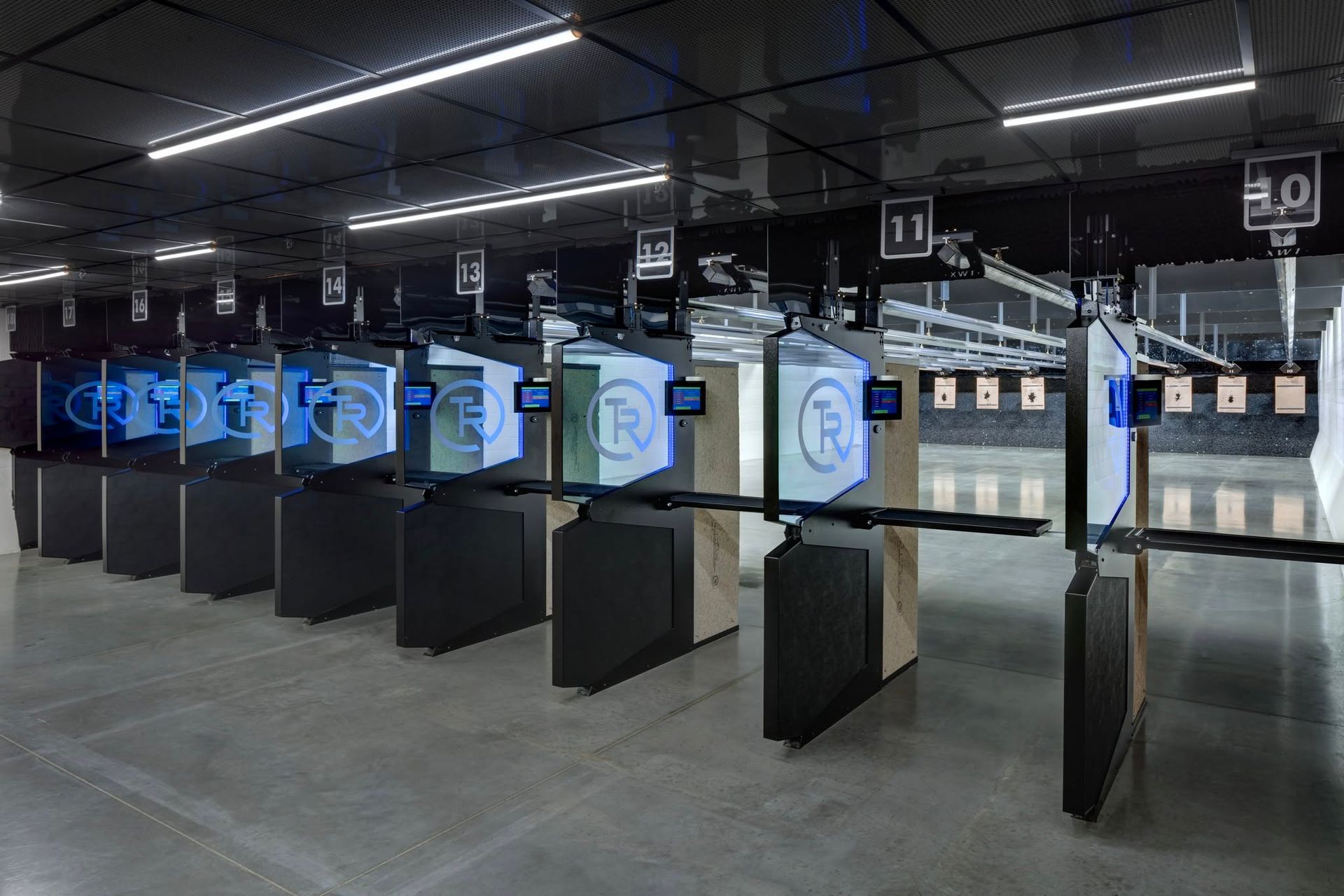
The Range in McKinney runs 18 climate-controlled lanes rated for pistol and rifle out to 25 yards, and the questions we get asked most cover what you can bring and who can shoot. Come and put five rounds on paper before you touch a turret.
Frequently Asked Questions
Can I zero a rifle at 25 yards?
You can set an initial zero there, and it is a standard way to start. Army guidance describes grouping and zeroing at 25 meters, then states that the most important step is confirming the zero at the intended distance, because a close zero does not guarantee a centre hit further out.
Why does my rifle shoot high at 100 yards when it is zeroed at 25?
Because the bullet crosses your line of sight twice. Army guidance puts the near crossing at approximately 25 meters from the muzzle; between that point and the far zero distance, the bullet travels above your line of sight.
Should I adjust my sights or work on my shooting?
Fire a group and judge it by its own spread rather than by its position. Military doctrine puts grouping before zeroing precisely because tight, consistently placed groups are the evidence that aiming and trigger control are working. Adjusting before that point moves an unstable average.
What can I practise at an indoor range that transfers to distance?
Trigger control, what the manual calls "sight alignment", position and stability, recoil management, reloading, and malfunction handling. All are range-independent. The one thing a short indoor lane cannot teach is reading wind and light, because there are none.
Is shooting indoors safe from a lead exposure point of view?
Federal guidance identifies gun smoke, bullet fragmentation at the trap, and handling spent cartridges as exposure routes, and recommends a dedicated push-and-pull ventilation system with HEPA filtration rather than a building's standard HVAC. As a shooter, avoid eating or drinking in the range area and wash hands and face afterwards.
The Range in McKinney
415 Industrial Blvd., McKinney, TX 75069
Tuesday–Saturday 10 a.m.–7 p.m. | Sunday 12 p.m.–6 p.m. | Closed Mondays
·
Schedule
a
lesson
·
Plan an event