Indoor Shooting Range Etiquette: 12 Rules Every New Shooter Should Know
Indoor shooting range etiquette comes down to three principles: keep your firearm pointed downrange at all times, keep your finger off the trigger until you are ready to fire, and treat every other person on the range as someone you might shoot accidentally if you stop paying attention. Beyond those, the 12 rules in this guide cover the practical etiquette that separates a confident range visitor from the new shooter who makes everyone uncomfortable. Most rules are about predictable, slow, deliberate behavior. The range officer's job is enforcement; the experienced shooter's job is quietly modeling good behavior. Get these right, and any indoor range in McKinney or anywhere else will welcome you back.
Rule 1: Treat every firearm as loaded
This is the first rule of firearm safety and the foundation of all range etiquette.
What it means in practice:
- Pick up a firearm only if you intend to handle it deliberately
- Even immediately after unloading and showing clear, treat the firearm as if a round could still be in it
- Do not "casually" wave a firearm around even if you "just emptied it"
- Pass a firearm to another person only with the action open, magazine out, and pointed in a safe direction
Why it matters:
Most accidental discharges happen with "unloaded" firearms. The owner forgot a round in the chamber, or a round was chambered during a clearance attempt, or the magazine was reinserted by mistake. Treating every firearm as loaded eliminates this failure mode.
Common mistake:
A new shooter brings a personal firearm to the range, says "it is empty," and starts demonstrating their grip while pointing the muzzle around the lane area. Even if the firearm truly is empty, this looks unsafe and makes everyone around the lane nervous.
Correct behavior:
Keep the firearm cased until you are at the lane bench. When you remove it, point the muzzle downrange immediately and keep it there.
Rule 2: Never point the muzzle at anything you are not willing to destroy
The muzzle is the dangerous end. Where it points matters constantly.
At the indoor range, the muzzle should be pointed:
- Downrange (toward the target) when the firearm is in your hand
- Into the lane bench (downrange angle) when set down
- Toward the floor at the lane edge if you must briefly handle the firearm during a malfunction
The muzzle should never be pointed:
- Toward another lane
- Toward the lobby or door
- Toward the ceiling (in indoor ranges with concrete ceilings, ricochets are a real concern)
- Toward your own foot, leg, hand, or any part of your body
- Toward an RSO who is approaching to help you
The "muzzle sweep" rule:
A muzzle sweep means the firearm muzzle crossed in front of another person (or yourself). Even if the firearm was unloaded and the trigger was not pressed, a muzzle sweep is one of the worst range etiquette violations. Experienced shooters notice and remember.
Common scenario causing muzzle sweeps:
A new shooter has a malfunction and turns toward the RSO with the firearm in hand, muzzle pointing at the RSO's leg. The correct behavior: keep the muzzle pointed downrange, and use your voice or free hand to signal the RSO. The RSO comes to you.
Rule 3: Keep your finger off the trigger until ready to fire
The trigger finger is the second control point. Use it deliberately.
Where your trigger finger should be:
- Pressed flat against the frame of the firearm above the trigger guard
- Visible to anyone looking at you (it should be obvious you are not holding the trigger)
When the trigger finger goes on the trigger:
- After the firearm is aimed at the target
- After your decision to fire is made
- After you have positively identified the target
When the trigger finger comes off:
- Immediately after firing
- During any movement of the firearm (turning the firearm, moving down the lane, etc.)
- During any malfunction
- During reloading
The "trigger guard" rule:
Some new shooters rest their finger on the trigger guard, just outside the trigger. This is not safe enough. The finger should be off the firearm entirely (pressed against the frame above the trigger guard) when not firing.
Common mistake:
A new shooter's finger drifts onto the trigger as they aim. They press as they breathe out. The shot fires before they are mentally ready. This is "anticipation" and is the cause of most flinch problems. Deliberate trigger placement (off until ready, on only when committed) prevents this.
Rule 4: Be sure of your target and what is beyond it
At an indoor range, this rule applies less than outdoors, but still matters.
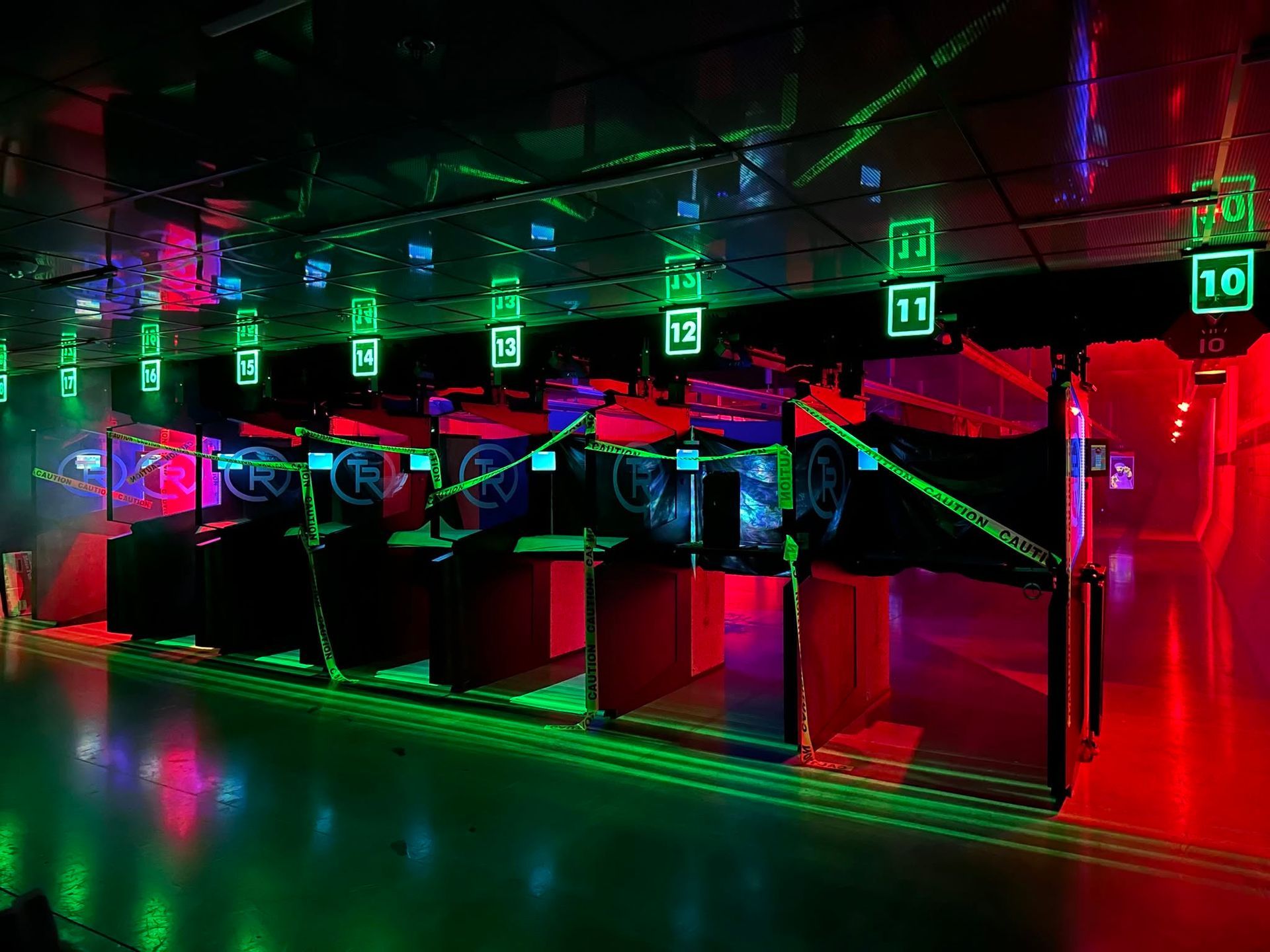
Indoor range targets are confined to:
- Your own target hung on your lane
- Backstop (the angled steel or rubber wall at the back of the range that captures bullets)
- Lane ceiling and side walls (impacts here mean missed shots)
Common indoor mistakes:
- Shooting at someone else's target by accident
- Shooting too high (above the target) and impacting the ceiling instead of the backstop
- Shooting too low (below the target) and impacting the floor
- Hitting the lane partition with a stray shot
How to avoid:
- Confirm your target is in your lane and at an appropriate distance
- Aim deliberately at the center of mass of your target
- Pull the target back to a closer distance if you cannot consistently hit it
- Stop shooting and ask the RSO for help if you cannot land shots reliably
Outdoor range applies more rules: target identification, terrain, and what is beyond the backstop. These do not apply to a well-designed indoor range with a steel trap backstop.
Rule 5: Move firearms only when the lane is clear
A firearm in motion is a firearm potentially in someone's muzzle path.
When to move a firearm:
- From its case to the bench (downrange muzzle direction immediately)
- From the bench to your hand (slow, deliberate, muzzle stays downrange)
- From your hand back to the bench (action open, muzzle pointed downrange)
- Back into the case at the end of the session
When NOT to move a firearm:
- During a cease-fire (firearm stays on the bench, unloaded)
- When other lanes are actively firing (your firearm stays put)
- When someone is downrange (rare in indoor ranges; never move a firearm)
- In the lobby or parking lot (firearm stays cased)
The "downrange transition" rule:
When you pick up a firearm from the bench or set it down, your muzzle traces a small arc. Make this arc downrange. Do not lift the firearm in a way that crosses the side partition or ceiling.
Common mistake:
A new shooter picks up the firearm with the muzzle pointing left (toward the next lane) and then rotates it downrange. Better: pick up the firearm with the muzzle already downrange and the grip oriented in your hand.
Rule 6: Eye and ear protection on before crossing the firing line
The firing line is the front of the lane bench. Beyond that point, firearms are being fired. Protect your eyes and ears at all times in that zone.
What this means:
- Eye and ear protection on in the lobby before walking through the lane door
- Eye and ear protection stay on for the entire time in the lane area
- Eye protection (clear glasses) stays on even if you have to clean your sights or check the firearm
Specifically about ear protection:
- Foam plugs: roll, insert, hold for 30 seconds to expand. Test by talking; your voice should sound muffled.
- Electronic earmuffs: power on, position fully on the crown of your head, ear cups completely covering the ears.
- Double protection (foam plugs + earmuffs): recommended for new shooters who are sensitive to noise.
Common mistakes:
- Earmuffs sitting on top of the temple of glasses, creating a gap (loud noise reaches the ear)
- Foam plugs not fully inserted (only blocking partial noise)
- Removing protection in the lane area to wipe sweat or itch (immediately puts you at risk)
A note on eye protection:
Eye protection prevents brass casings from hitting your eyes, fragments of ricochet from impacting your face, and dust or smoke from the range from irritating. Even if a session feels "easy," a casing in the eye is permanent damage.
Rule 7: Stay in your lane physically and visually
The lane is yours. The lanes next to you are not.
Physical rules:
- Your body stays within your lane's partition lines
- Your firearm stays within your lane
- Your bench area stays within your lane
- You do not stick your head or any part of your body past the firing line
Visual rules:
- Do not stare into other lanes
- Do not comment on other shooters' performance
- Do not video other shooters without permission
- Do not point at other shooters or their targets
The "lane bubble" concept:
Each lane is an independent shooting environment. You are responsible for your own lane and nothing else. The shooter next to you may be doing something unusual, but it is the RSO's job to manage that, not yours.
Common mistake:
A new shooter looks over at the next lane to see what the other shooter is doing, especially if they are doing rapid fire or shooting unusual targets. This breaks your concentration on your own lane and creates safety risks. Eyes on your own target.
Rule 8: Pick up brass only when the range is cold
Brass cases land on the floor of the lane. They are yours unless the range collects them.
Safe brass pickup:
- Only during a cease-fire when the entire range is cold
- Only after confirming with the RSO that you may step forward of the firing line
- With the firearm unloaded, action open, on the bench
Unsafe brass pickup:
- Bending down with a loaded firearm in your hand
- Reaching forward of the firing line while shooting is happening
- Crossing into another lane to pick up brass that bounced
Some ranges:
- Allow brass pickup at any time within your lane bubble (no firearm in hand, do not step forward)
- Have a brass-sweeping rule for after each session
- Collect all brass for resale or recycling (do not pick up at all)
Check the rules at check-in. Some indoor ranges actively discourage shooters from picking up their brass because it slows down lane turnover.
Rule 9: Communicate with the RSO using clear signals
Hearing protection makes voice communication difficult. Use clear signals.
Common signals:
- Raised hand: "I need help" or "I have a question"
- Pointing to your ear: "I cannot hear you"
- Thumbs up: "I understand" or "I am ready"
- Step back from the bench: "Approach when ready"
- Wave the RSO over: Either with hand up or with a clear gesture
Specific situations:
- Malfunction you cannot clear: step back, raise your hand, wait for the RSO
- Lost something on the floor: ask the RSO before reaching for it
- Need to leave the lane briefly: tell the RSO, secure your firearm
- Lane is too cold or too hot (climate complaint): the RSO has a thermostat
Common mistake:
Trying to shout over hearing protection to ask the RSO a question. Either step out of the lane to the lobby where you can remove protection, or use hand signals to get the RSO to come to you.
Rule 10: Do not coach other shooters unsolicited
This is one of the most common etiquette violations and the most annoying for experienced shooters.
What unsolicited coaching looks like:
- Walking up to another lane and saying "you should hold the gun like this"
- Commenting on another shooter's stance from across the range
- Suggesting different firearms or ammunition
- Telling someone their target placement is wrong
Why it is problematic:
- The other shooter did not ask
- You may be wrong about technique
- You distract their focus and lane time
- You disrupt the range social environment
When it IS appropriate:
- The shooter asks you a question
- The RSO asks you for help
- Safety issue (someone violating a clear safety rule) where you alert the RSO, not the shooter directly
The exception for friends and family:
If you came to the range with someone you brought specifically to teach, you are coaching them. That is fine. But still: focus on your own person, not the strangers around.
Rule 11: Clean up your lane before leaving
The next shooter wants the same clean environment you wanted.
Before leaving the lane:
- Pick up any trash (ammo boxes, target backings, used drinking cups)
- Wipe down the bench if it has lead residue or powder (some ranges provide wipes)
- Remove your target from the clamp
- Push your target down to the back of the lane track (or follow range procedure)
- Reset the lane lighting if you adjusted it
- Bring your range bag and case with you
What stays on the range:
- Brass casings (usually; check range policy)
- Any range-provided eye and ear protection that is loaner
- The target hanger and partition
Common mistake:
Leaving a partially-used box of ammo on the bench, expecting to come back. Bring everything with you. The next shooter is not your storage solution.
Rule 12: When in doubt, ask
Range rules vary. RSO discretion varies. When you are unsure, ask.
Topics to ask about:
- What ammunition is permitted at this range
- What firearms are restricted
- Specific reload procedures for this range
- Photo and video rules
- Procedures for handling a malfunction
- How to do something unusual (dry-fire practice, holster work, etc.)
How to ask:
- Step back from the bench (your firearm staying in the lane)
- Approach the RSO or lobby staff calmly
- Ask the specific question briefly
- Listen to the answer
What to avoid:
- Asking questions while actively shooting
- Asking the RSO to make exceptions to range rules
- Asking other shooters (the RSO is the authority)
- Asking about another shooter's technique without their permission
Contact us The Range in McKinney
The unwritten etiquette experienced shooters watch for
Beyond the 12 written rules, experienced shooters watch for subtle behaviors.
The pace: New shooters often fire too fast. Take your time. A 50-round session in 60 minutes is unhurried and professional. A 50-round session in 5 minutes looks frantic and unsafe.
The reload: New shooters fumble reloads visibly. Practice in slow motion at home (dummy rounds, no real ammo) to make reloads smooth.
The recovery from a malfunction: Calm, deliberate. No panic. If you do not know what to do, set the firearm down on the bench, action open, muzzle downrange, and signal the RSO. Do not turn the firearm around to look at it.
The dress and demeanor: A neat-looking shooter in appropriate clothing communicates competence. A shooter in flip-flops with a tank top and a brand-new $1,500 pistol communicates inexperience.
The choice of firearm: Experienced shooters bring firearms they can actually shoot well. Showing up with a Desert Eagle .50 caliber as a first-time shooter is a tell. Match firearm to skill level.
The respect for the RSO: Experienced shooters greet the RSO, ask for advice, and follow instructions promptly. New shooters sometimes argue or push back. The RSO is the authority.
The cleanup: Experienced shooters leave the lane cleaner than they found it. New shooters sometimes leave a mess.
The voice level: Range is loud. Voices outside hearing protection range carry differently than expected. Keep conversation at a moderate level.
The phone: Phones in the lane are increasingly common but distracting. If you take a photo, do it briefly and put the phone away. Long phone calls or texting at the lane wastes your time and the lane's time.
FAQ's
What happens if I break a rule?
Minor rule violations (talking too loud, picking up the wrong brass) get a verbal correction from the RSO. Major safety violations (muzzle sweep, finger on trigger when it should not be) can get you removed from the range, sometimes permanently.
Can I bring my own targets?
Most ranges allow paper or cardboard targets. Restrictions on hard targets (steel, etc.) and on targets with offensive imagery are common. Verify at check-in.
Are children allowed at indoor ranges?
Most McKinney indoor ranges allow ages 8+ with parent supervision and active engagement. Specific rules vary. Confirm before bringing kids.
Can I shoot rapid fire?
Most indoor ranges restrict rapid fire (more than a certain number of rounds per minute). The reason: lead and powder accumulation in the ventilation, plus safety concerns with multiple shooters in close quarters. Follow the range's specific rule.
Can I bring my dog?
Generally no, except for certified service dogs. Service dogs are usually permitted but should remain in the lobby area, not on the active range.
Can I drink alcohol at a gun range?
Absolutely not. Most ranges prohibit alcohol on the premises and immediately suspend members caught violating. Save the post-range beer for after you leave.